Fireblocks alternatives: choosing wallet infrastructure for your next stage
Compare Fireblocks alternatives by treasury workflows, embedded wallets, DeFi operations, and policy enforcement to find the right operational fit.
· 8 min read
On this page
The short answer
If Fireblocks is on your shortlist, you already know you need governed wallets, an API, and a policy engine. Every credible alternative offers those three things. What actually decides the purchase is narrower: where the rules are enforced, who runs the automation signer, which chains and counterparties you need, and whether the pricing model matches your volume.
Here is the shortlist we would give a friend, organized by the job you are hiring the wallet to do.
| If your main job is | Start with | Why it earns the slot |
|---|---|---|
| Stablecoin payouts, pay-ins, and PSP operations | Utila | Sponsored transfers in the base product, deposit and sweep guides, an API co-signer that runs in your environment, and a published entry plan |
| Frequent DeFi and protocol interaction | Fordefi | Simulation built into approval and policy, contract-level rule conditions, and broad non-EVM coverage |
| Open smart accounts you control end to end | Safe | Open-source contracts deployed on hundreds of EVM networks, extensible with modules and guards, self-hostable services |
| Wallets embedded in your own product | Turnkey or Privy | Enclave-based signing, user authentication, and per-wallet policies designed for developers |
| Treasury, payments, and WaaS with rules enforced onchain | Den | One policy engine run independently by the signing client, a Guardian service, and audited smart contracts |
Den publishes this blog. Read the last row as our position and the others as the way we would describe them to a peer.
Why teams look past Fireblocks
Fireblocks is a mature platform and none of what follows argues otherwise. Its developer documentation describes direct-custody wallets built on a 3-of-3 MPC scheme with a single master key per workspace, unlimited vault accounts, and exchange and network integrations that apply to direct custody only. Its platform overview explains that the policy engine runs inside Intel SGX enclaves and that rules are signed by a quorum of admins before they take effect.
Teams usually start a search for alternatives for one of four reasons.
The plan does not match the volume. Fireblocks publishes a self-serve entry plan and moves to quote-based tiers above it on its pricing page. A payments startup or a treasury team with modest activity often finds usage-based or lower entry plans elsewhere. Pricing changes often, so compare current pages rather than anything quoted in a blog post, including this one.
Trust is anchored in the vendor's infrastructure. The MPC shares that Fireblocks holds and the policy engine that evaluates every transaction both live in Fireblocks-operated enclaves. Fireblocks documents this as a strength, and enclaves are a legitimate security boundary. Some security teams still prefer controls they can verify independently, for example in open-source contracts on a public chain.
The workload has a different shape. Fireblocks grew up around custody and trading, with the Fireblocks Network and exchange accounts as central features. It does cover payments and DeFi: a Gas Station for EVM fees, an Automation add-on for sweeps, rebalancing, top-ups, and triggered transfers, and transaction simulation and dApp protection for contract interactions. The question is whether you want those as parts of a large platform, some of them sold as additions, or as the core of a narrower product built around your workload.
Embedded wallets are a separate product. Fireblocks offers Embedded Wallets on a 2-of-2 MPC arrangement with one share on the user's device, and recommends running them in a separate workspace from direct custody. Dedicated embedded-wallet providers bundle authentication, session management, and export flows that a consumer product needs on day one.
Utila: for stablecoin payment operations
Utila positions itself as stablecoin and digital asset infrastructure for fintechs and enterprises. The documentation backs up the payments focus. Sponsored transfers let a gas wallet pay network fees for deposit wallets, natively on major EVM chains, Solana, Sui, and Aptos, with policy enforced at the deposit wallet rather than the gas wallet. The docs index also includes API guides for deposit monitoring and sweeping token balances to treasury, and an address book with grouped entries.
Automation runs through a co-signer delivered in the Utila CLI. It runs in your infrastructure, polls the vault, and signs only transactions designated to its service account. In webhook mode it forwards each transaction to your endpoint and refuses to sign if that endpoint fails to answer, which is the right default for a payout engine. Webhooks are signed with RSA-4096 and retried with exponential backoff for up to 24 hours.
On the security model, Utila states that private keys are split between the customer and Utila, that every device has a cryptographic identity approved by multiple admins, and that policies can only be changed by an admin quorum. It lists SOC 2 Type II and audits by Halborn. Those are vendor statements and worth confirming in diligence.
Tradeoffs: like Fireblocks, Utila holds a key share and evaluates policy off-chain, so the trust model is similar even if the product focus differs. Utila also publishes its own comparison with Fireblocks. It is useful reading, and it is marketing. We compare the two in depth in Fireblocks vs Utila.
Fordefi: for DeFi-heavy desks
Fordefi describes itself as an MPC wallet, security platform, and Web3 gateway for builders, traders, and operators. Its emphasis is what an approver sees and how that feeds policy. Before approval, Fordefi resolves the contract into a verified human-readable name, simulates the transaction, and flags risks. Simulation results also feed the policy engine: rules can match on USD value of outgoing or net amounts, on external screening results, and on decoded ABI parameters, according to the policy rules documentation.
Key material is split in two, with the customer share on a device or an API Signer you run yourself and the Fordefi share inside AWS Nitro secure enclaves. Chain coverage is wide: the supported blockchains page lists 13 chain families including 50 or more EVM networks, Solana, Cosmos, Bitcoin, Sui, Aptos, TON, and TRON. Backups can use threshold recovery phrases, a YubiKey, an air-gapped public key, or third parties such as Coincover and Station70, per the backup documentation.
Tradeoffs: the policy engine still runs in vendor infrastructure, the documentation allows one API Signer per organization, and payment-operations tooling is not the emphasis. See Fordefi vs Fireblocks for the head-to-head.
Safe: for teams that want to own the account
Safe is not a vendor platform in the same sense. It is an open-source smart account whose core model is a set of owners and a confirmation threshold, deployed as a proxy on hundreds of EVM networks. The rules live onchain, so anyone can verify who can move funds. Modules add behaviour such as spending allowances or recovery, and a transaction guard adds checks before and after owner-signed transactions, with a separate module guard available for module-initiated ones where the contract version supports it.
That openness is the strength and the cost. The core contract enforces the threshold. Richer controls come from extensions: the Allowance module for spending limits, Safe Shield for transaction previews and risk insights with an optional Guardian by Hypernative transaction guard that can block high-risk transactions, Workspace roles in Safe Wallet, or guards and modules you deploy. Safe warns that a malicious module can take over a Safe and that a broken guard can lock one. The default interface exports history as CSV but excludes zero-value transactions such as approvals and owner changes. Safe is addressing the organizational layer with Safe Pro, which its early partner announcement says launches on October 6, 2026 with pricing to follow.
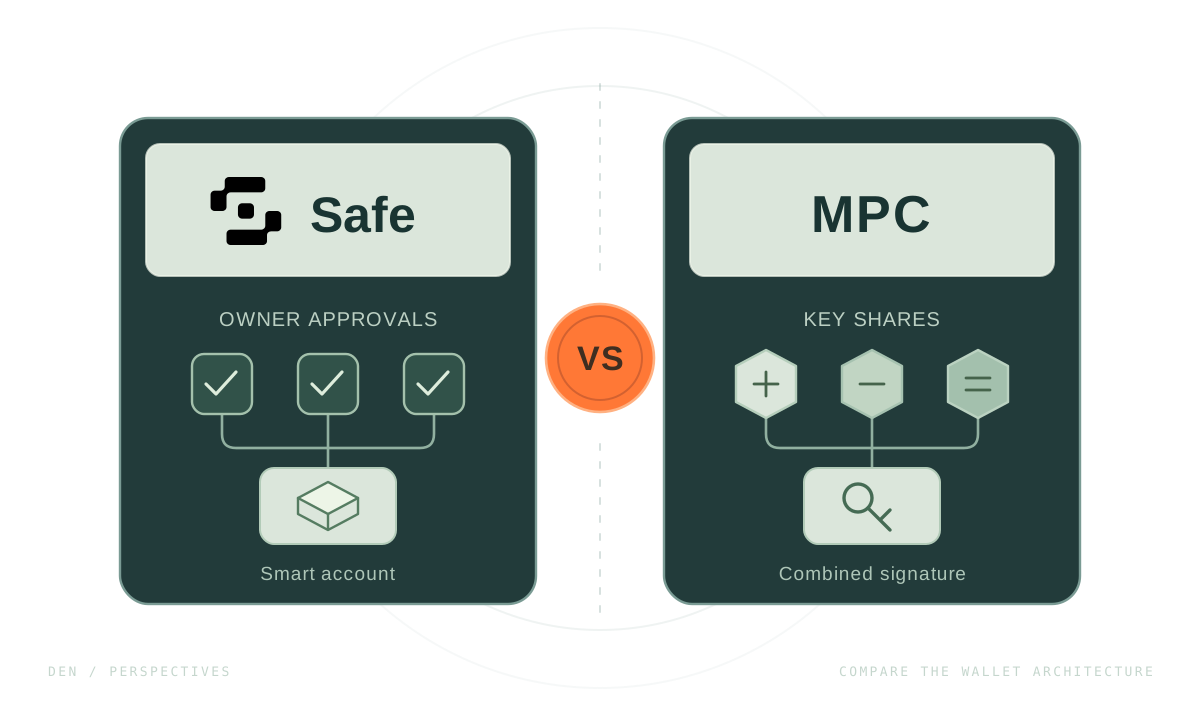
Choose Safe when your engineers want a public, composable account and are prepared to design the operating model around it. Our Safe wallet review goes through the details, and Safe vs MPC wallets explains why the two are different layers rather than competing products.
Turnkey and Privy: for wallets inside your product
If the requirement is issuing wallets to your own users, Fireblocks Embedded Wallets compete with two developer-first providers.
Turnkey runs key generation, signing, and its policy engine inside AWS Nitro enclaves. Policies are JSON objects with an effect, a consensus expression, and a condition, evaluated with implicit deny. End users live in sub-organizations that the parent can read but not act in. Turnkey Verified publishes attestation proofs for address derivation and policy outcomes. Pricing is usage-based per signature on its pricing page.
Privy bundles authentication with wallets. Keys are split with Shamir secret sharing into an enclave share and an auth share, and reconstructed only inside an AWS Nitro enclave for signing. Once attached to a wallet, policies deny anything they do not allow and are evaluated in the enclave. Stripe announced its acquisition of Privy in June 2025, and Privy continues as an independent product. Its pricing scales with monthly active users.
Tradeoffs: both are developer primitives. Turnkey policies can require consensus from several users and Privy supports key quorums, so organizational controls are possible to assemble, but neither ships a treasury console with approval queues and finance-friendly reporting as a product. Turnkey vs Privy covers the decision.
Den: for rules that survive a compromised server
Den's Multi-Layer Security Wallet takes a different position on the question of where rules should live. Every standard transaction is checked against the same policy three times, by the signing client, the Guardian service, and the onchain contracts. The signing client is either the mobile app or the TypeScript SDK, which refuses to produce signable data for a transaction that violates policy. The Guardian re-validates on the server. The contracts verify the policy and the required approvals again before executing, so a compromised dashboard or server cannot by itself move funds outside the rules.
Policies cover auto-approval or M-of-N manual review by members or groups, filters on source account, initiator, token, recipient allowlists and amount, contract-level rules on address, function and argument values, and rate limits per initiator, account or destination over a time window. Governance changes such as adding members or editing policies require the organization's admin threshold, which you can set above one so that no single administrator can change the rules.
Automation uses API members whose signing keys you hold in your own KMS, HSM, or air-gapped device. Den covers network fees within a plan allowance. The contracts are open source and were audited by Certora and yAudit in 2026. Deployment can be Den Cloud, your own cloud, or on-premise, and disaster recovery offers two timelocked paths that keep working if the Guardian is permanently unavailable.
Limitations are real and worth stating. Den supports EVM networks only, currently Ethereum, Arbitrum One, Base, Optimism, and Ronin, with new networks deployable on request. There is one SDK, in TypeScript. In the standard flow the Guardian is operated by Den, so teams that want full independence use the self-hosted option. Den does not offer exchange connectivity comparable to the Fireblocks Network.
How to make the call
Four questions separate these options faster than a feature checklist.
- Where must the rule be enforced? In the vendor's infrastructure (Fireblocks, Utila, Fordefi, Turnkey, Privy), in a smart account you configure with optional guards (Safe), or in all of the signing client, a server, and the chain (Den). Fireblocks, Fordefi, Turnkey, and Privy document that infrastructure as secure enclaves. Utila's pages we read do not name the server-side hardware.
- Who runs the automation signer? Fireblocks, Utila, and Fordefi all let you host a co-signer or API signer holding a key share. Den's API members sign with keys you already manage. Safe automation runs through modules or delegated keys you deploy.
- Which chains and counterparties are non-negotiable? Non-EVM coverage points to Fordefi, Utila, or Fireblocks. Exchange settlement points to Fireblocks. EVM-only treasury and payments open up Safe and Den.
- What does exit look like? Ask each vendor what you can do without them. Safe accounts keep working without any company. Den documents Guardian and Transaction Recovery with timelocks. MPC vendors document key backup procedures that you should test before you need them.
For the finance side of the decision, read crypto treasury wallets for finance teams. If you are choosing infrastructure for a product rather than an internal treasury, start with the best wallet infrastructure for fintechs.